















Indicators · Momentum & oscillators
Know Sure Thing
A smoothed momentum oscillator built from several rate-of-change periods.
Origin: Martin J. Pring, early 1990s
- Best suited to
- Trending markets
- Responsiveness
- Lagging
- Family
- Momentum & oscillators
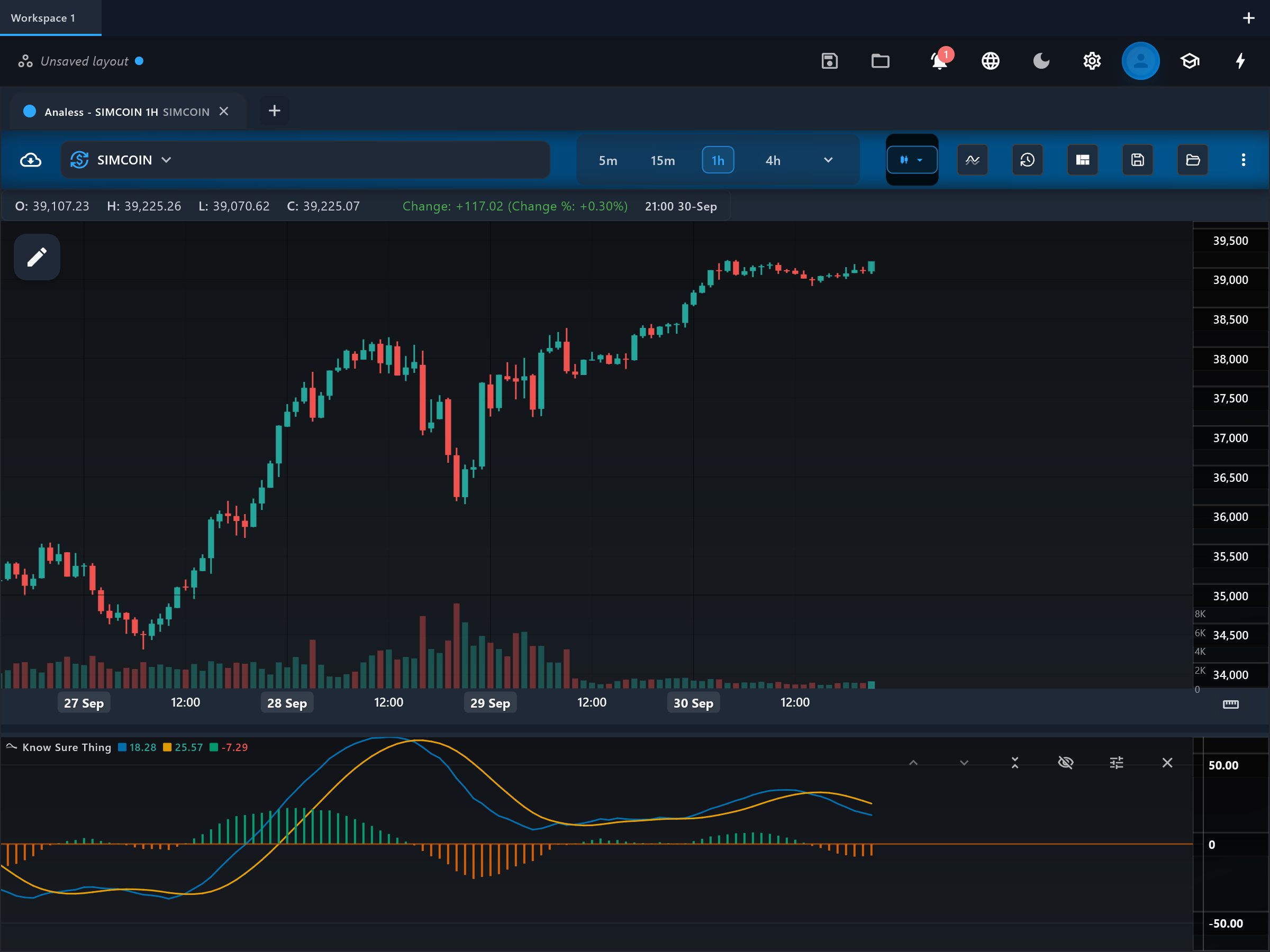
What it is
Know Sure Thing (KST) is Martin Pring's multi-timeframe momentum oscillator. Instead of measuring momentum over one lookback, it blends four rates of change — from short to long — into a single smoothed line, so that one indicator reflects several momentum cycles at once. It comes with a signal line and oscillates around zero.
How it is calculated
Four rate-of-change values are computed on the chosen source (defaults 10, 15, 20, and 30 periods). Each ROC is smoothed with its own simple moving average (defaults 10, 10, 10, and 15 periods) to form four smoothed momentum legs. The legs are then combined in a weighted sum — weights 1, 2, 3, 4 — so the longest cycle counts most. The result is the "kst" line; a simple moving average of it (default 9 periods) forms the "signal" line, and their difference is drawn as the "histogram".
How to read it
Watch three things: the "kst" line against its "signal" line, the "kst" line against the "zero" level, and the "histogram" that shows the gap between the first two. KST above zero and rising reflects broadly positive momentum across the four cycles; below zero and falling, the opposite. Crosses of "kst" over "signal" are the primary triggers, with the zero line adding trend context. A shrinking histogram warns that a cross may be coming.
What to look for
- Signal-line crossUpside
The "kst" line crosses above the "signal" line — the standard bullish trigger, strongest when it happens below zero after a decline.
- Signal-line crossDownside
The "kst" line crosses below the "signal" line, warning that blended momentum has rolled over.
- Centre-line crossUpside
KST crosses above zero, confirming that the weighted sum of all four momentum cycles has turned positive.
- Centre-line crossDownside
KST crosses below zero, confirming broadly negative momentum.
- DivergenceContext
Price makes a new high or low that KST fails to confirm — Pring treated divergences at extremes as early reversal evidence.
When to use it
KST works on any liquid market, but Pring applied it primarily to stocks and indexes across daily, weekly, and monthly charts — with different parameter sets per horizon (the defaults here are the daily/short-term set). It rewards patient, swing-to-position trading where its smoothing is an asset. Avoid it for fast intraday scalping or in choppy ranges, where its heavy smoothing makes crosses late and frequent enough to whipsaw.
Works well with
Settings explained
roc1Period- Lookback of the shortest rate-of-change leg, default 10. This leg reacts first; shortening it makes KST turn earlier but noisier.
roc2Period- Lookback of the second ROC leg, default 15. Together with the others it spaces the four momentum windows across the cycle spectrum.
roc3Period- Lookback of the third ROC leg, default 20 — an intermediate momentum cycle with weight 3 in the blend.
roc4Period- Lookback of the longest ROC leg, default 30. It carries the highest weight (4), so this setting dominates KST's overall shape.
smoothPeriod1- SMA length applied to the first (shortest) ROC leg, default 10. More smoothing quiets the fastest leg; less lets it inject more short-term wiggle.
smoothPeriod2- SMA length applied to the second ROC leg, default 10 (Pring's published value for this leg).
smoothPeriod3- SMA length applied to the third ROC leg, default 10 (Pring's published value for this leg).
smoothPeriod4- SMA length applied to the longest ROC leg, default 15. Because this leg has the largest weight, extra smoothing here has the biggest calming effect on the whole line.
signalPeriod- Length of the SMA that forms the "signal" line, default 9. Shorter gives earlier but more frequent crosses; longer delays them.
source- The price field all four rates of change are computed on; close is the standard choice.
Limitations and common mistakes
- Four ROCs, four SMAs, and a weighted sum add up to substantial lag — KST turns well after price at short horizons.
- The default parameters are Pring's short-term set; weekly and monthly analysis traditionally uses different, longer sets.
- In trendless markets the kst/signal pair crosses repeatedly near zero, generating whipsaws.
- It is unbounded, so there are no fixed overbought/oversold levels — extremes are only meaningful relative to the instrument's own history.
References
- Origin: Martin J. Pring, early 1990s.
- KST oscillator — Wikipedia (opens in a new tab)
This page explains how an indicator is calculated and read. It describes past data, not what price will do next, and it is not a recommendation to trade. Read the disclaimers.
Try it in Analess
Add Know Sure Thing to any chart, adjust its settings, and open this explainer from the indicator itself.